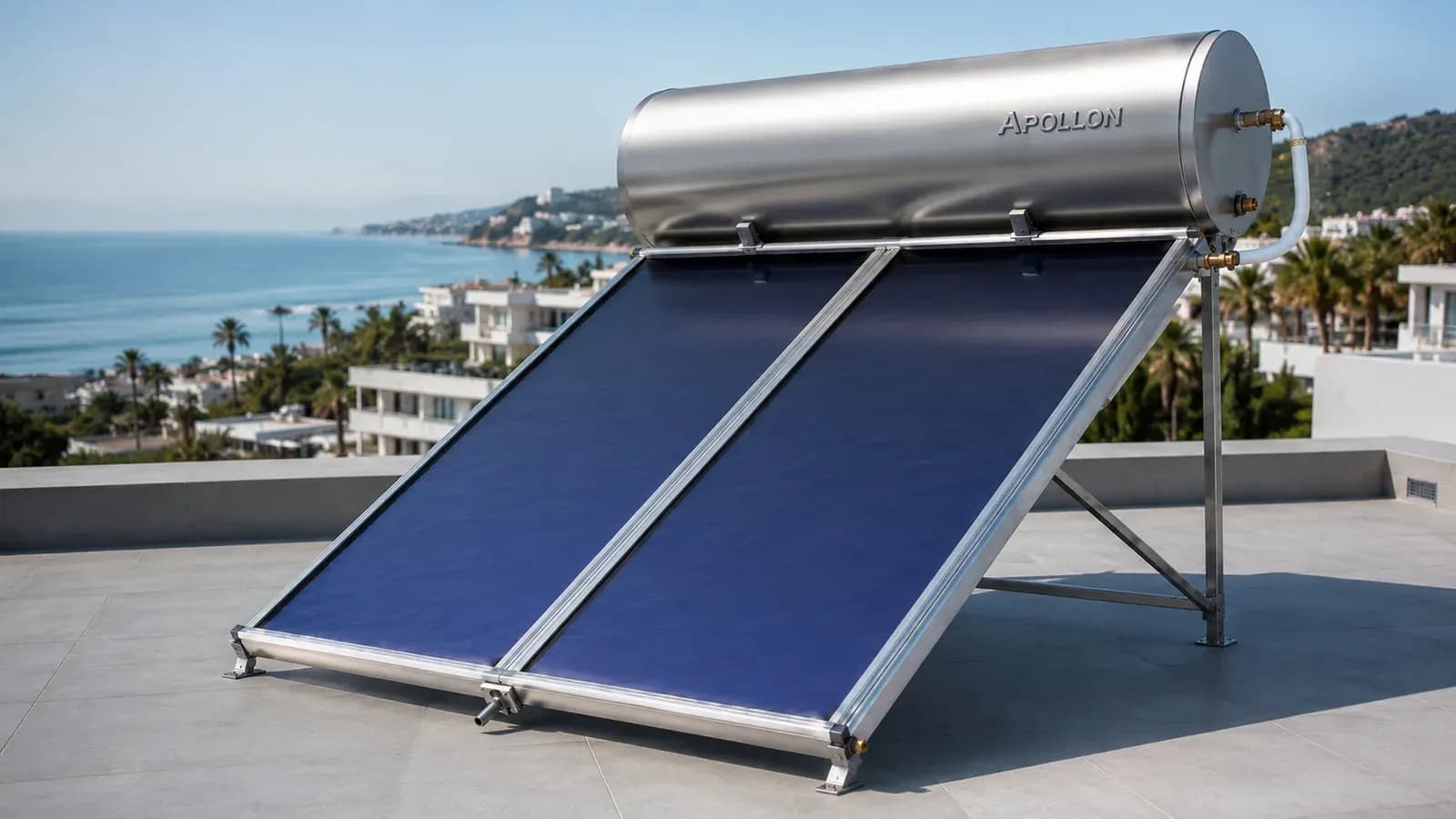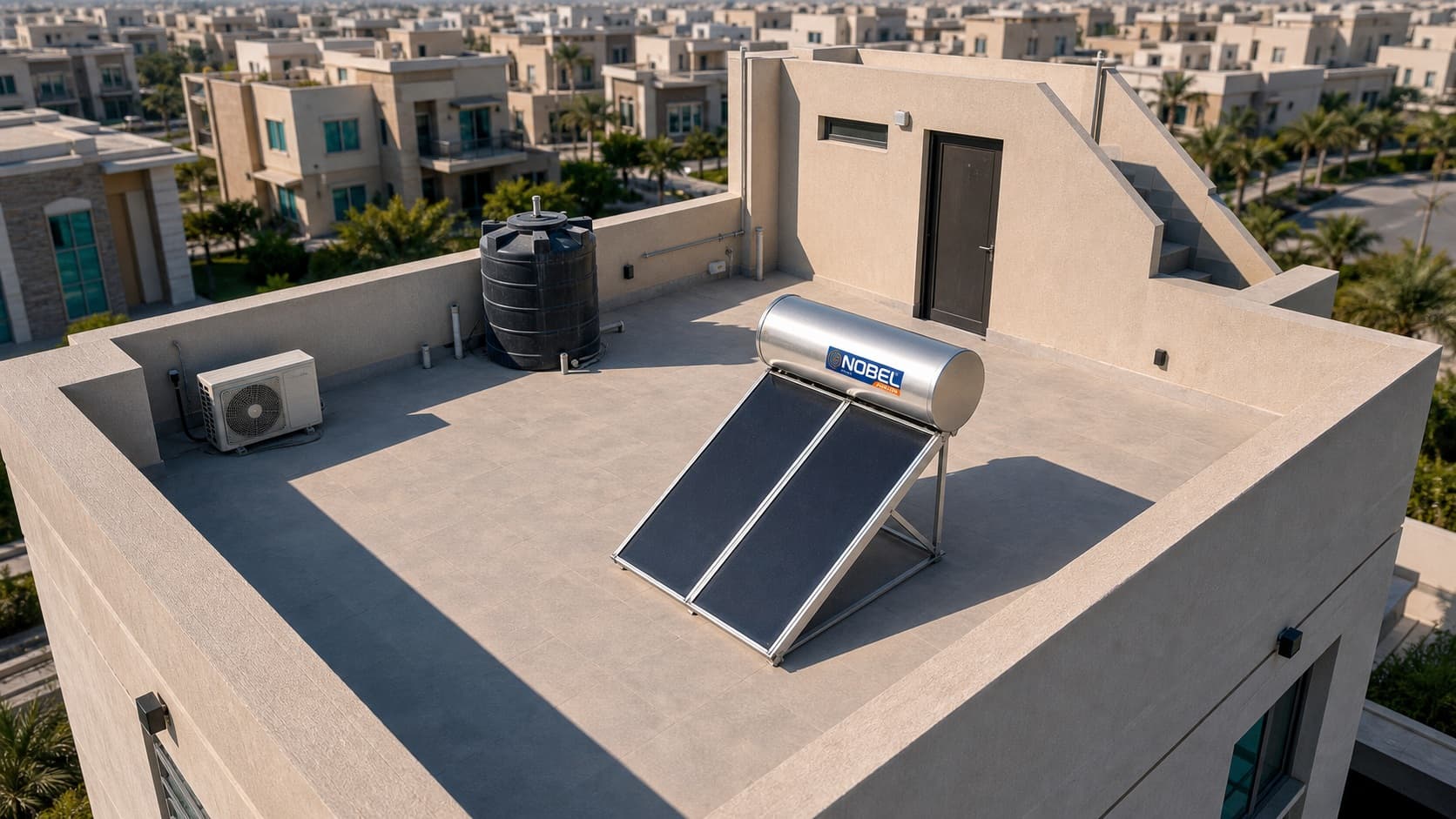

A domestic solar water heater needs a collector area of 2.6 square metres for a 200 L unit, and 4 square metres for two collectors in a 330 L system (Nobel Apollon's certified figures). But that is the area of the panel itself — the roof that actually works needs more: clearance in front so it isn't shaded, a path behind the tank for servicing, and a tilt angle that makes the system "take" more length than its width. On most Egyptian roofs that area is easily available, and the real problem is usually not space — it's shade and ownership.
This article tells you exactly what to measure, how to know if your roof works before you call anyone, and the options if the roof is tight or not yours. It follows on from solar heater installation and maintenance, which covers the whole installation — here we focus on the space question.
The base number: the collector
The collector (panel) sets the area. By capacity:
- 200 L system (4–5 people): one collector of 2.6 m².
- 330 L system (6–8 people): two collectors totalling 4 m².
In domestic systems the tank sits above the collectors on the same mount, so it takes no notable extra floor area. The capacity that suits you is set by headcount and usage pattern — find your right capacity before you measure.
Why the real footprint is larger than the collector number
Four reasons:
- Tilt. The panel isn't laid flat — it's mounted at an angle facing south to catch the sun most of the year. A tilted panel takes less floor than its length, but the mount and tank add height, and that height casts shade behind the system.
- Shade clearance in front. Anything taller than the panel and in front of it to the south (a high parapet, a roof room, a water tank, a taller building) shades it at certain hours — especially in winter when the sun is low. There must be enough distance between the panel and any obstacle to its south.
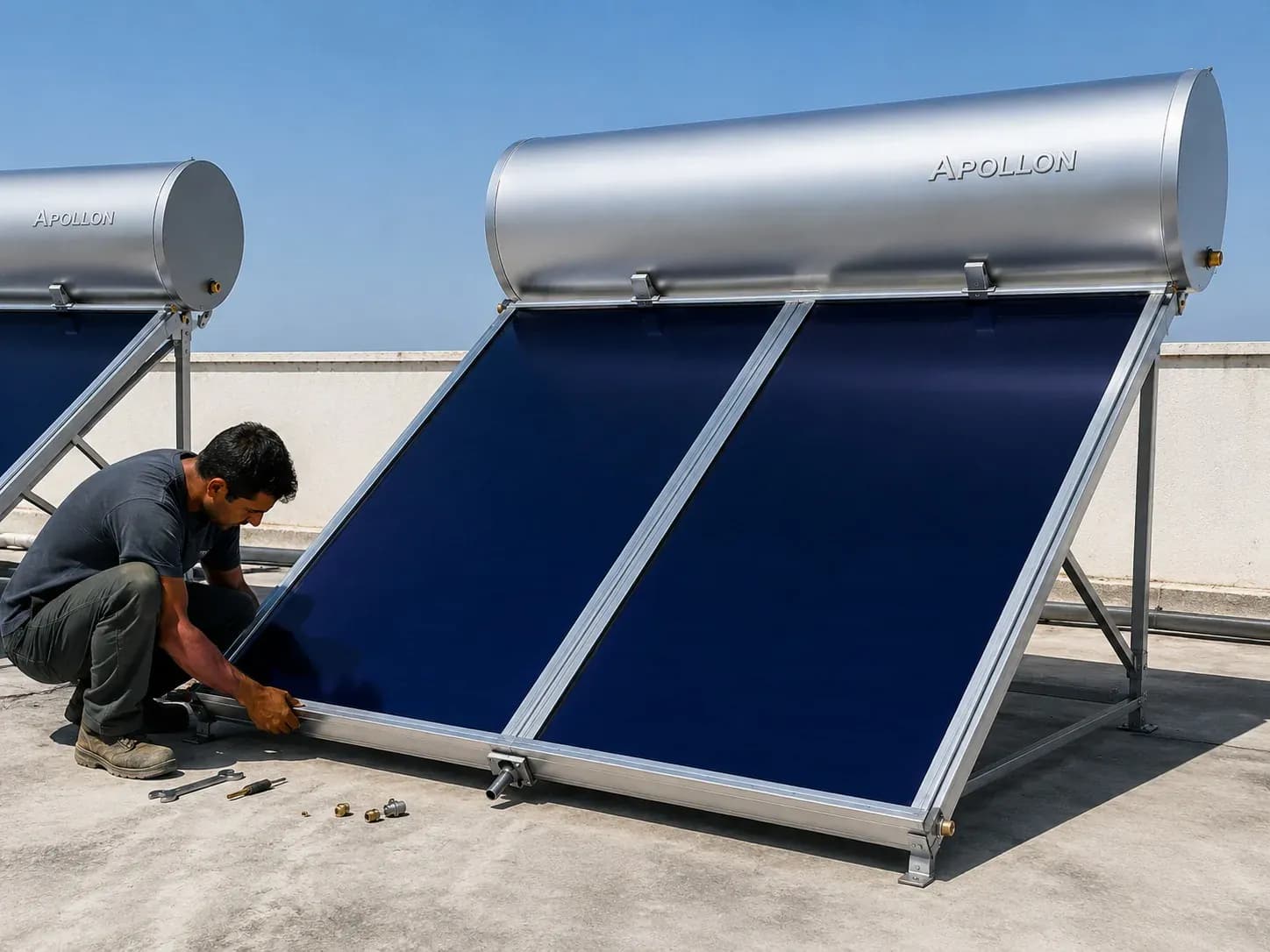
- Service path. The technician needs to reach the tank (anode, valve, backup element) and the collectors (cleaning). A system wedged against the parapet on every side is a misery to service.
- Pipe route. Hot and cold pipes need a route from the system to the drop into the home. Not a large area, but it must exist and not cut across a walkway.
Rule of thumb: allow roughly double the collector area of clear roof that sees south without obstacles — a first estimate; the inspection gives the actual figure.
How to measure your roof yourself before calling anyone
- Find south. Your phone's compass is enough. The side the sun is on at midday.
- Find the largest clear area that sees south with nothing taller in front of it on that side.
- Measure it. If it's more than double the collector area you need — it probably works.
- Watch the shade at midday and mid-afternoon. Shade from a neighbouring building in winter matters more than the area itself.
- Find the drop point. The nearest place pipes can descend into the home — the closer, the cheaper the installation, covered in solar heater installation cost.
Orientation and angle in detail: best place to install a solar heater.
If the roof is tight or crowded
Not a rare case — Cairo apartment roofs are full of water tanks, dishes and rooms. Options, in order:
- Better layout. Often the roof has the area but scattered. The inspection checks whether the system fits in a south-facing corner between the obstacles.
- The unit that suits the space. A 200 L system with one collector takes less than a 330 L with two — if consumption allows.
- Forced circulation. If there's no room for the tank up top, there are systems where the tank goes inside the home and only the collectors sit on the roof — forced circulation system. Less roof area, but a larger system.
- If there's no sun at all: then the alternative isn't a solar heater — a heat pump or gas. And we say so, rather than install a system that won't perform.
If the roof isn't yours
In shared buildings the roof belongs to the owners' association or the landlord. Three things from real installations:
- Ask first. Most associations agree once they know the system takes limited space, doesn't damage the waterproofing — and that the company takes responsibility for the fixing.
- Waterproofing is a red line. Fixing must not breach the roof membrane, and that's our job, not yours.
- A central heater for the whole building is a solution that often comes out of this question — one system feeding every flat instead of each resident claiming a patch — central solar heater for a residential building.
Villas: the space is there — the problem is the shape
In villas the question isn't "is there space?" — it's "where?". The roof is often sloped, tiled or multi-level, and the owner doesn't want the system visible from the street. The inspection balances south (performance), appearance (façade) and pipe route — and there's usually a solution that satisfies all three.
The practical takeaway
- Collector: 2.6 m² for a 200 L unit · 4 m² for two collectors at 330 L.
- Real roof: roughly double that, facing south, shade-free in winter, with a service path.
- The real problem is rarely area — usually shade or ownership. Both have solutions.
Find your right capacity so you know which system you're measuring for, and book a free inspection — we measure roof, shade and route in one visit and tell you honestly whether it works.
Frequently Asked Questions
How much roof space does a solar heater need?
The collector itself is 2.6 m² for a 200 L unit and 4 m² for two collectors in a 330 L system. The real roof needs roughly double that, facing south without shade, with a service path.
Why is the real footprint larger than the panel area?
Because of the tilt angle and the height that casts shade, the clearance needed in front to the south so it isn't shaded in winter, a path for the technician to reach the tank, and a route for the pipes.
How do I measure my roof?
Find south with your phone's compass, find the largest clear area that sees it with nothing taller in front, measure it, and watch the shade at midday and afternoon. If it's more than double the collector area, it probably works.
My roof is tight — is there a solution?
Yes. A 200 L unit with one collector takes less, or a forced-circulation system with the tank inside the home and only collectors up top. If there's no sun at all, the alternative is a heat pump or gas — and we say so.
The roof isn't mine — what do I do?
Ask the association first; most agree once they know the system takes limited space and doesn't breach the waterproofing. There's also the option of one central heater for the whole building, which removes the question entirely.
Is shade more important than area?
Usually yes. A large roof with a taller building to its south shading it in winter is worse than a smaller open one. The inspection checks shade across the day, not just the area.
Got a question about what you just read?
Talk to Aurora's team directly for a straight answer — or book a free site inspection if you're ready.