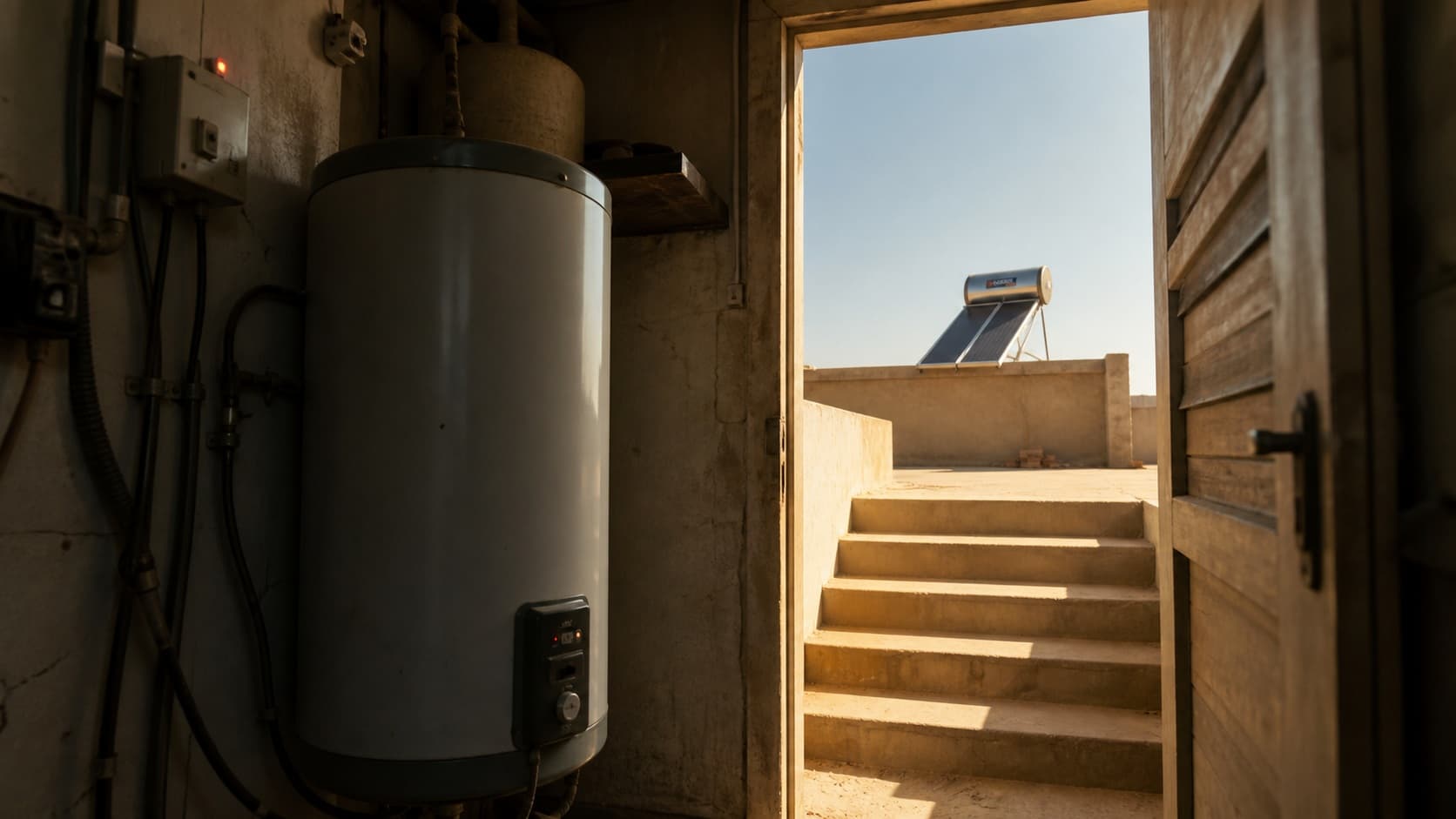
In short: an electric heater is cheaper upfront and simpler to install, but it heats with electricity around the clock, so the monthly bill stays consistently higher. A solar heater costs more upfront and needs a suitable roof, but it heats from the sun for free, so it saves you money over the long run. The right choice comes down to two questions: do you have a roof that gets sun, and how much do you actually use? This article compares the two honestly, by the numbers, without tilting toward either option, so you can decide clearly.
The cost difference — upfront and monthly
Solar heater · Electric heater
Upfront cost · Higher (system + installation) · Lowest
Monthly bill · Lowest (heats from the sun) · Higher (daily electric heating)
Long term · Pays back its cost, then saves · Cost keeps stacking on the bill
Needs roof/sun · Yes · No
Installation · Slightly more involved · Simple
The exact figures for your home — price, bill, and payback period — are set during the free inspection, but the structural difference in the table holds regardless of your specific house: electric has you paying every month, solar has you paying more once upfront and then less on the bill afterward. Maintenance factors into the equation too — a solar heater kept up with regular maintenance holds its efficiency and its savings for years, and you can see what that maintenance involves in Maintenance.
The comparison is not between two appliances — it is a system versus an appliance
The fundamental difference the table does not state: an electric heater is a finished product you buy and fit in any home, while a solar heater is a system tailored to yours. That is why four things matter for solar and barely matter for electric:
- Material quality: with electric, the gap between models is limited. With solar, the gap between good and weak materials is the gap between a system holding steady efficiency for years and one that drifts down quietly until you are paying again — on the bill and on maintenance.
- Specification: with electric you pick a size off a shelf. With solar the size is calculated — and too little capacity has the backup element running daily, meaning you paid for a solar system and are back to paying for electricity.
- Consumption: the heavier your use, the wider the gap opens in solar's favour. And for a household with very light use, electric can genuinely be the sensible answer — that is our honest view, not a slogan.
- Fit with the house: electric sits indoors and nobody sees it. Solar sits on the roof and is visible, and its position is shaped by the façade and by compound rules where they exist — a real factor in the decision before it is a factor in the price. All four are covered in the price article.
The honest drawbacks of each option
There's no perfect option, and honesty here matters more than the sale:
- Electric's drawback: it heats with electricity every single day without exception, so the bill stays a fixed monthly burden no matter how cheap the unit was to buy. And as electricity prices rise over time, that burden grows rather than shrinks.
- Solar's drawback: the upfront cost is higher, it needs a roof that gets sun and has enough space, and installation is a bit more involved than electric. On cloudy days it partly relies on the backup heater. We cover these drawbacks in full honesty in Solar heater drawbacks, and how to deal with any potential fault in Solar heater faults and fixes.
The goal isn't to hide a flaw to close a sale — it's for you to go into the decision seeing the full picture.
So which one actually suits you?
Let's be straightforward instead of selling:
- Solar suits you if: you have a roof that gets sun, your usage is medium to high, and you want real savings over the long term. Here solar clearly wins, because the monthly bill drops and the upfront cost pays itself back.
- Electric suits you if: there's no suitable roof at all, your usage is very low and individual, or your budget right now is tight and you need a quick, cheap solution.
This neutrality is intentional — the best decision is the one that genuinely fits your home, not the one we're trying to sell you. For the wider picture on the decision, read Is a solar heater worth it?.
If you go solar, which tier suits you?
If your usage is moderate and your budget is tight, the economy heater tier gives you the same core benefit — free heating from the sun — at a cost closer to electric. If your usage is higher (a villa, a large household), a higher tier like Nobel Hyperion gives you proven performance over the long run. The right tier is set by your actual usage, not by the highest price available.
Lifespan and maintenance change the equation
The money comparison isn't complete without factoring in time. An electric heater's simple installation doesn't change the fact that the monthly bill stays there for as long as you use hot water — year after year, with no accumulated saving. A solar heater is the opposite: once its upfront cost is paid back through savings, it keeps saving you money for close to free for years, provided it's kept up with simple, regular maintenance. Neglecting maintenance is the single biggest thing that erodes a solar heater's efficiency over time, which is why we always recommend a clear maintenance plan from day one — whether that's periodic maintenance or emergency maintenance coverage if something breaks unexpectedly. Compared side by side, maintenance costs over the years stay well below the bill difference you'd have paid choosing electric instead.
Can I start with electric and switch to solar later?
Yes, and it's a realistic option if your budget is tight right now. There's nothing stopping you from installing electric now and planning to switch to solar once you're financially ready, as long as the roof is still available and suitable when that time comes. The one thing worth doing: if you're planning to switch eventually, ask about the right roof space from the start, so you don't need extra modifications when you make the switch. The decision doesn't have to be final on day one.
So how do I decide?
The decision needs three things: knowing whether your roof is suitable, knowing the cost-and-savings picture for your home, and choosing a trustworthy installation company (because installation quality affects lifespan and performance as much as the product itself does — details in How to choose a reliable installation company). We settle all three during the free inspection — we see your roof, learn your usage, and tell you honestly which option saves you more.
Find your right capacity ← then Book a free inspection and we'll tell you honestly: solar or electric for you.
Frequently Asked Questions
Solar or electric — which is cheaper?
Electric is cheaper upfront; solar is cheaper long-term if you have a sunny roof and decent usage, because it heats from the sun for free.
When is electric the better choice?
When there's no suitable roof, usage is very low, or the upfront budget is limited.
Is the bill difference significant?
Solar clearly cuts water-heating bills because the main source is free; the size of the difference depends on your usage and electricity rate.
Does maintenance affect the total cost between the two?
Yes — solar needs simple periodic maintenance to keep its efficiency and savings, while electric's maintenance is simpler but its monthly consumption stays fixed. Details in [Solar heater faults and fixes](/en/blog/اعطال-السخان-الشمسي-وحلولها).
Is there a middle ground between solar and electric?
Every solar heater already includes a built-in electric backup that only runs when needed (cloudy days), so you're effectively getting the benefit of both rather than choosing just one.
Got a question about what you just read?
Talk to Aurora's team directly for a straight answer — or book a free site inspection if you're ready.