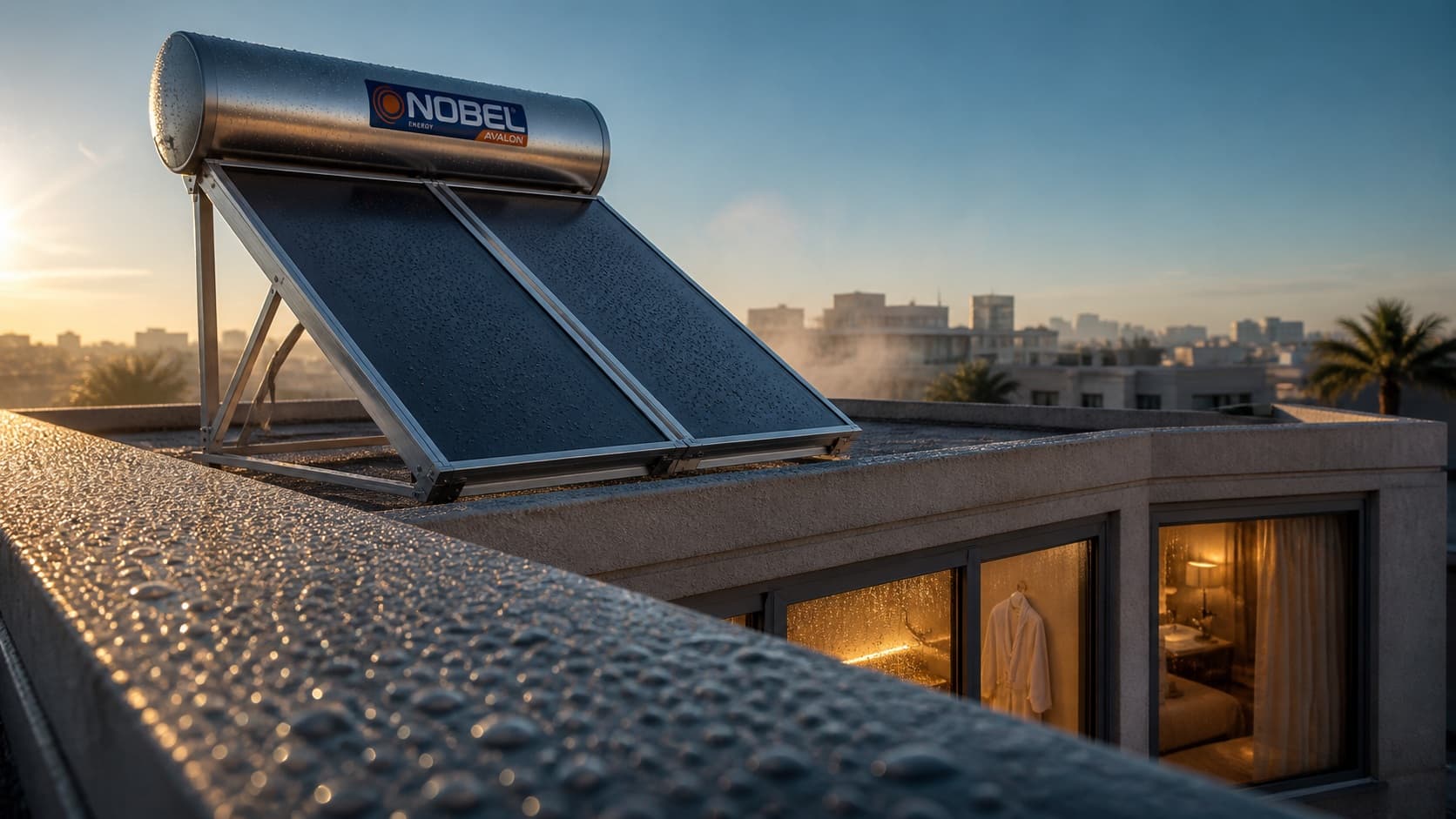
Yes, a solar water heater works in winter — it's the question that worries people most before they buy. Output drops on cloudy days but doesn't stop altogether, which is why good models like Nobel Apollon come with a backup electric element that switches on automatically once the sun weakens, so you don't get stuck with cold water on a grey day. You're guaranteed hot water year-round; only the heat source shifts with the weather.
How hot does the water stay in winter?
On a sunny winter day — which, geographically, is most winter days in Egypt — the panels heat the water normally and the insulated tank holds that warmth for hours, even after sunset. The real challenge is several cloudy days in a row, when reduced sun means reduced natural heating over an extended stretch. That's exactly where the backup electric element takes over.
The core difference between summer and winter isn't that the system "stops" in winter — it's that less energy reaches the panels because the sun sits at a lower angle and daylight hours are shorter. The system works exactly the same way; its main input (sunlight) is just smaller, which is what makes the backup element's role more visible in winter than at any other time of year.
How does the backup electric element actually work?
It runs on a simple thermostat: when the tank's water temperature drops below a set point — because of reduced sun — the element switches on automatically to finish the heating job, and switches off again once the sun brings the water back up naturally. Electricity only steps in when it's genuinely needed, unlike a plain electric heater that reheats from scratch every single time. The result: guaranteed hot water with the least electricity possible compared to full electric heating.
So will I be paying for electricity in winter?
Honestly — during long stretches of clouds, the backup element will run and genuinely use electricity. That's not a marketing dodge; it's just physics. But that usage is partial and temporary, not continuous heating all day the way a conventional electric heater works. The rest of winter's sunny days, and all of summer, run on the sun for free. For the full comparison between relying entirely on electricity and relying on the sun, see How much does a solar water heater save?
A common misconception is thinking the backup element runs "all winter long" — it doesn't. It only activates when the water temperature actually falls below the threshold, typically on cloudy days or late at night after heavy hot-water use. On a normal sunny winter day, the backup element may not switch on at all, because the sun alone covers what's needed.
Do different systems handle winter differently?
Not every system tolerates winter equally well. Advanced systems like Nobel Apollon come with better-engineered insulation and design specifically aimed at reducing heat loss in cold weather — a difference that shows up more clearly in winter than in summer. Economy systems still work and still save money, but the performance gap on cold days tends to favor the higher-spec systems more visibly. Choosing the right system for your budget and actual usage is what settles this — not automatically defaulting to the most expensive option — and that's exactly what the inspection clarifies instead of you having to guess.
What actually makes the difference in winter performance?
Not all solar heaters behave the same way in winter. What genuinely matters:
- Insulation and tank quality: a well-insulated tank holds heat longer through cold nights, even without extra sun.
- Panel orientation and placement: a roof that gets sun for the longest stretch of the day performs noticeably better in winter specifically, when the sun's angle is lower. We confirm this on-site during the inspection.
- System type: systems with forced circulation benefit more from precisely timed pumping on short winter days, improving efficiency specifically in that season.
- The right capacity: a tank too small for a large family runs out faster in winter because natural heating is slower. Correct sizing genuinely matters — find your right capacity.
That's why the right choice and correct installation matter far more to your winter experience than the model name alone. Installation itself affects performance — you can read about how long solar water heater installation takes and how it's done. For the bigger-picture decision, see Is a solar water heater worth it?, and the full list of drawbacks in Solar water heater drawbacks.
What about haze and light cloud cover?
In light cloud and haze, the panels still capture a meaningful share of the sun's heat — direct, strong sunlight isn't a requirement for absorption to happen. Output drops somewhat but doesn't stop. It's only heavy, consecutive cloudy days where the backup element runs noticeably. The practical difference between a sunny day and a hazy one is usually not something you'll notice in water temperature, though it might show up in how fast the water reheats after heavy use on the same day.
Should I prepare the heater before winter?
A simple check before winter starts genuinely helps — confirming the panels are free of summer dust and that the tank and connections are sound improves performance through the first wave of clouds. Periodic maintenance covers this check, and emergency maintenance is available too if something fails mid-winter. Homes that do this annual pre-winter check see far fewer surprises — the tank and panels go into cloud season in their best possible condition.
Does winter performance vary by region?
Winter weather isn't uniform across Egypt — Greater Cairo and the Delta cities see more cloud cover than Upper Egypt, for instance, and coastal areas like the North Coast get more humidity and haze specifically in winter. None of this rules out solar anywhere, but it does affect how much you'll rely on the backup element. In areas like Fifth Settlement and Sheikh Zayed, we factor this in when designing the system and recommending capacity.
Winter performance is decided by the same four factors
Winter does not change the rules of the system — it exposes them. The four factors that set the system and its price are the same ones that decide how winter feels:
- Material quality shows in winter more than at any other time. The gap between good and weak insulation is barely noticeable in summer; on cold nights it is the difference between water still hot in the morning and water gone lukewarm.
- Specification decides how much you lean on the backup. Correct capacity means the backup covers the shortfall on a handful of days; capacity below what you need has it running almost daily all season.
- Fit with the house changes with the season. The winter sun sits lower in the sky, so shade that did not exist in summer can fall across the panels for part of the day. A spot measured only against summer can let you down in winter.
- And consumption rises without anyone noticing. Showers run longer and the incoming water is colder, so the system works harder against higher demand at the same time — which explains most "it was fine and now it isn't" complaints.
In other words, most winter complaints are not a seasonal fault; they are a factor that was calculated for summer only.
The winter takeaway
If you're considering a solar heater and specifically worried about winter, that worry is understandable but doesn't match how the system actually performs. Egyptians who already have solar heaters go through winter normally, and the only difference they notice is the backup element switching on occasionally on cloudy days — nothing more dramatic than that.
The bottom line: a solar water heater in Egypt gives you hot water year-round — the sun carries most of the heating load, and the backup element covers the rest on the coldest, cloudiest days, using as little electricity as possible. Book a free inspection and we'll check your roof and put your mind at ease about winter performance before you buy — or find your right capacity first.
Frequently Asked Questions
Does a solar water heater work in winter?
Yes; output only drops on cloudy days. Good models include a backup electric element that runs automatically once the sun weakens, so the water stays hot.
Will I pay a lot for electricity in winter?
No. The backup element runs only when needed, on cloudy days — not continuously — so usage is far lower than a plain electric heater.
Does the water cool down fast at night?
A well-insulated tank holds heat for a long time. Insulation quality and the right capacity make the real difference here.
Does haze or light cloud cover affect the heater?
Output drops somewhat but doesn't stop — the panels still capture part of the sun's heat. The real issue is heavy, consecutive cloudy days.
Should I prepare the heater before winter?
A simple check and cleaning of the panels and connections before winter starts improves performance through the first wave of clouds — it's a simple periodic-maintenance service.
Got a question about what you just read?
Talk to Aurora's team directly for a straight answer — or book a free site inspection if you're ready.