
The cost of installing a solar water heater is not a fixed number, and not a percentage of the unit price as many people assume. It is the result of six things in your home, not in the catalogue: the distance from the roof to the first bathroom, the floor you live on, the type of piping and its insulation, the roof mount, the electrical line for the backup element, and whether you need a pump. Two homes with the exact same heater can differ noticeably in installation cost — that is not overcharging, it is different work.
This article explains each of the six: why it matters, when it is large, and when it is close to zero. It follows on from solar water heater prices in Egypt, which covers what sets the price of the system itself — here we cover the part that comes after: the work.
Why is installation priced separately at all?
Because the unit is one thing and homes are all different. The tank and collectors are made in a factory to fixed specifications, so their price follows the specification. Installation happens on your roof: its height, its distances, the state of its pipes. A company that quotes one installation figure for everyone before seeing your roof is either pricing the worst case (you overpay if your home is easy) or the best case (and you get "extras" on the day).
The right way is for installation to be set after an inspection — which is exactly what we do. The inspection is free and the figure it produces is the figure that gets executed.
Item 1: distance from the roof to the first outlet
The biggest item in most homes. The heater sits on the roof; hot water has to reach your bathroom and kitchen. Every extra metre of pipe means more material, more insulation, more installation time — and more heat loss on the way. Distance doesn't only raise cost, it lowers performance if the pipes are poorly insulated.
- Close: a bathroom directly under the roof or on the top floor — least distance, least cost.
- Far: a kitchen on the opposite side of the flat, or two bathrooms at opposite ends — a longer run, sometimes two.
How to reduce it: if you are still finishing, keep the hot-water run from roof to bathrooms as short as possible. In an existing home, the inspection looks for the shortest feasible route without breaking walls.
Item 2: which floor you are on
In apartment buildings, the difference between a top-floor flat and a third-floor flat is not only vertical distance — it is the pipe route through light wells or the façade, the residents' permission, and sometimes scaffolding or work at height. All of that is counted.
The point people forget: the floor also affects pressure. A gravity (non-pressurised) system needs the tank high enough above the outlets — if the difference is insufficient, you either need a pump (item 6) or a pressurised system. That is covered in pressurised or non-pressurised.
Item 3: pipe type and insulation
Pipes carrying hot water on the roof are exposed to sun, heat and cold all year — unlike cold-water pipes inside a wall. The pipe type, the thickness of thermal insulation, and UV protection for that insulation all affect cost, and affect performance even more over time.
Cheap or exposed insulation crumbles within two summers, after which water reaches you cooler with nothing wrong with the heater. So when two quotes differ on "installation", ask: what are the hot pipes insulated with, and is the insulation protected from the sun? — that is usually where the difference sits.
Item 4: the roof mount and the roof itself
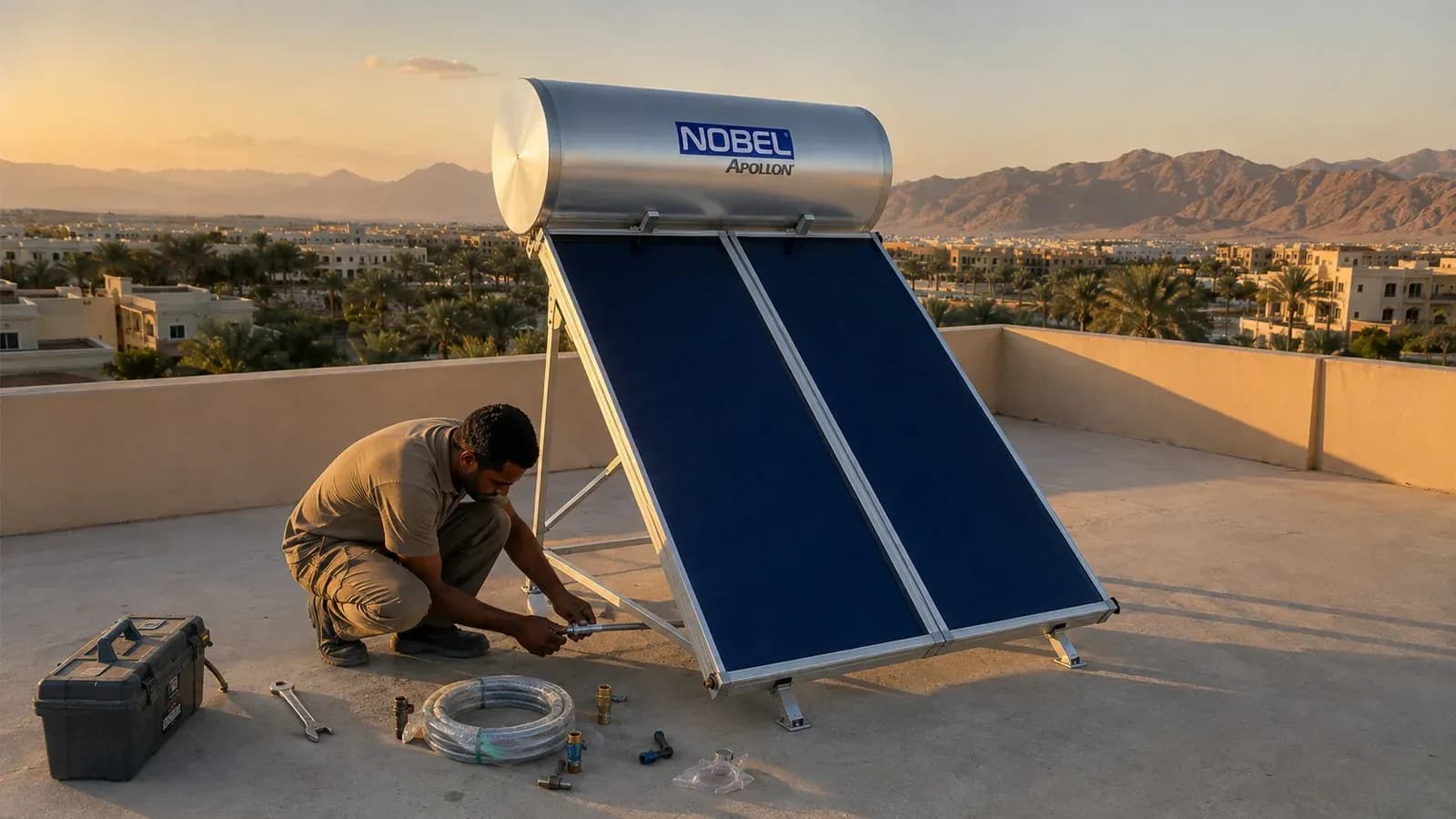
The heater is fixed to a metal mount, and the mount to the roof. The difference depends on the roof:
- Flat concrete roof: the easiest case — direct fixing.
- Sloped or tiled roof: needs a special mount at a different angle and more precise fixing.
- Roof with waterproofing: fixing must not breach the membrane — finer, slightly costlier work, but the alternative (a leak into the flat below) costs far more.
- Wind-exposed location (coast, very high floor): mount and fixing must withstand stronger wind.
The roof area itself is a separate topic — see how much roof space a solar heater needs.
Item 5: the electrical line for the backup element
The electric backup element is a standard component in solar water heaters — it runs on days the sun isn't enough. To work, it needs a dedicated line from the distribution board to the roof, on a suitable breaker. If the roof is far from the board, or the board has no room for another breaker, that is an added item.
Some people try to save this by plugging the backup into the nearest socket — don't. That is the leading cause of safety problems with electric heaters in general.
Item 6: the pump — not for every home
Not every installation includes a pump, and it matters to know that so you don't pay for one you don't need. A pump is necessary in three cases: the tank isn't high enough above the outlets, mains pressure in your area is weak, or the run to the farthest outlet is long. Otherwise, good design solves it without one — cheaper up front and cheaper to maintain.
And what does not affect installation cost?
For the full picture — things people assume raise installation cost that don't:
- The brand. Installing a Nobel is the same as installing any heater of the same type and capacity.
- A larger capacity. A 330 L system is installed in roughly the same steps as a 200 L — the difference is in the unit, not the work.
- The season. The work is the same in summer and winter. (What changes with the season is purchase timing as a factor in the system price — covered in the pillar article.)
How to read an installation quote
Three questions to ask any company before you sign:
- Is this figure after an inspection or before? If before, ask what could change on the day.
- What does it include, by name? Piping (how many metres), insulation (what type), mount, electrical line, pump (if any). Anything unlisted becomes an "extra".
- How many years is the installation warranty, and is it separate from the product warranty? The difference is explained in solar heater warranty.
We answer all three: a free inspection produces a written itemised figure, and that figure is what gets executed.
The practical takeaway
- Installation cost is set by your home, not the unit — distance, floor, piping, mount, wiring, pump.
- The two biggest items in most homes: distance and floor. The item most often cut wrongly: pipe insulation.
- The pump is not a fixed item — pay for it only if you need it.
Find your right capacity first so you know what you're installing, then book a free inspection to get an itemised installation cost for your own roof.
Frequently Asked Questions
How is solar heater installation cost calculated?
From six things in your home: distance from roof to the first bathroom, the floor, pipe type and insulation, the roof mount, the electrical line for the backup element, and whether a pump is needed. The figure comes after an inspection, not before.
Is installation a fixed percentage of the unit price?
No. Two homes with the same unit can differ because distances, floors and roofs differ. Any fixed figure before inspection is either priced for the worst case or will change on the day.
What is the biggest installation cost item?
In most homes, the distance between the roof and the outlets, then the floor in an apartment building. Every extra metre means more material, insulation and time — and more heat loss if insulation is poor.
Can I reduce installation cost?
Yes — by shortening the pipe route if you're still finishing, and by not paying for a pump if the design doesn't need one. What not to cut: hot-pipe insulation and a dedicated electrical line.
Does a larger heater cost more to install?
Not noticeably. A 330 L system is installed in roughly the same steps as a 200 L; the difference is in the unit price, not the work.
Does your inspection cost anything?
No, it's free. It produces a written, itemised installation cost for your roof — and that is the figure that gets executed.
Got a question about what you just read?
Talk to Aurora's team directly for a straight answer — or book a free site inspection if you're ready.