
There are three practical ways to heat a swimming pool, each on a different logic: a heat pump that moves heat from the air, a titanium-exchanger heater fed from a heat source (usually a boiler), or using a boiler you already have in the house.
And the choice is not "which is newest" — it comes down to two things: your operating season and the energy source available to you. This article sets out all three so you know what to ask.
The heat pump — cheapest to run
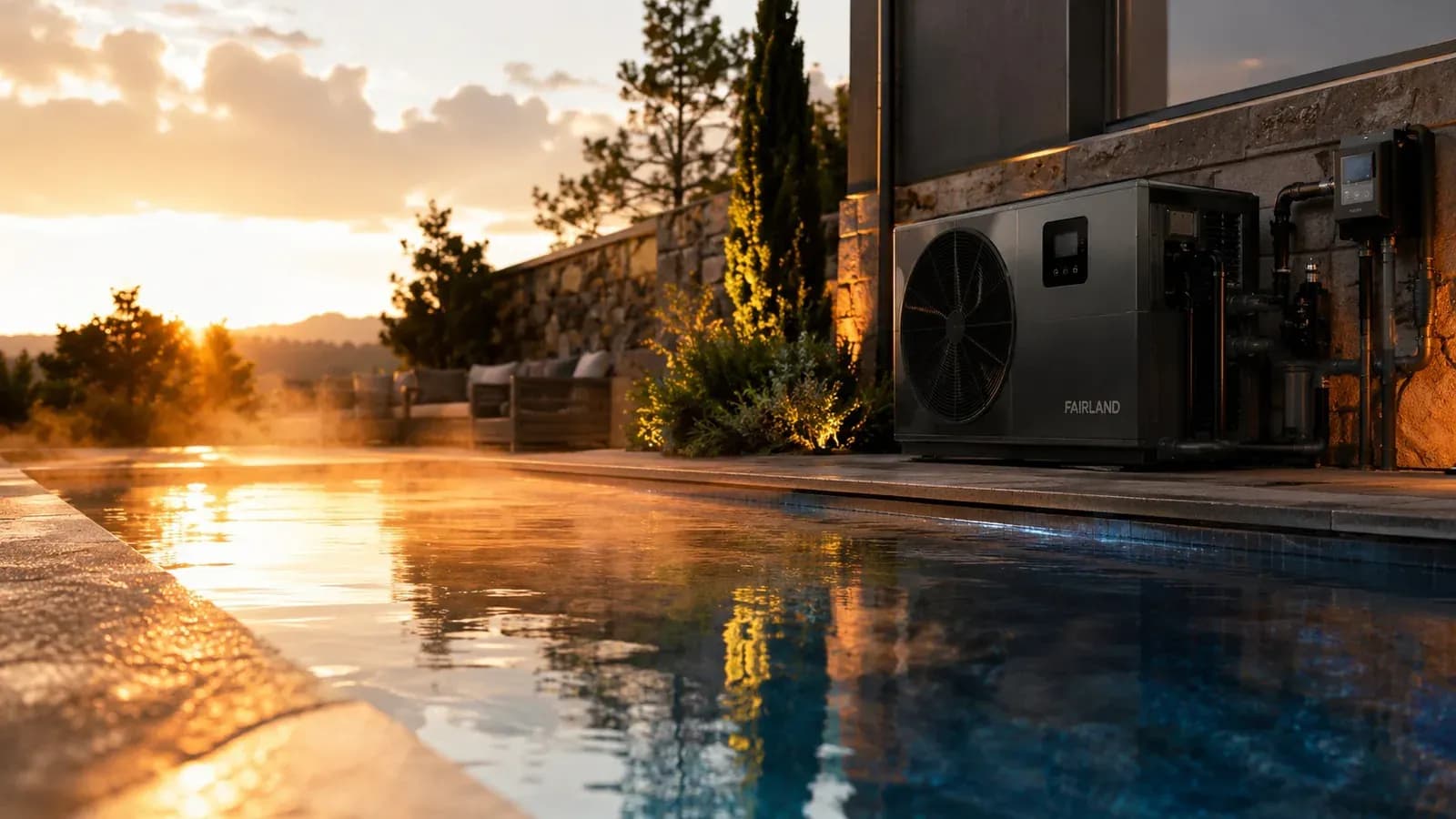
It works on the same principle as an air conditioner in reverse: a fan draws air, a refrigerant carries that heat into the water through an exchanger, and the water returns to the pool warmed through the existing filtration loop. It moves existing heat rather than making it — which is why its consumption is low.
It suits: pools running an extended season (spring, autumn and part of winter) · locations with no natural-gas network (its single best case) · anyone wanting a steady, calculable running cost.
Its real limit: efficiency falls as the air cools, because the air is where it draws heat from. So if you want a warm pool in deep January, it will not get you there efficiently on its own.
The approved specification we carry (LINUO RITTER): heating capacities of 28, 40.5 and 51.5 kW, a Panasonic Full Inverter compressor, R32 refrigerant, and a titanium-tube-in-PVC exchanger. Those capacities are maximum-performance figures at 28°C air, 80% humidity and 28°C water — that condition is part of the number, not a footnote, and any figure quoted without it turns a specification into a promise.
The titanium-exchanger heater — fastest and strongest in cold
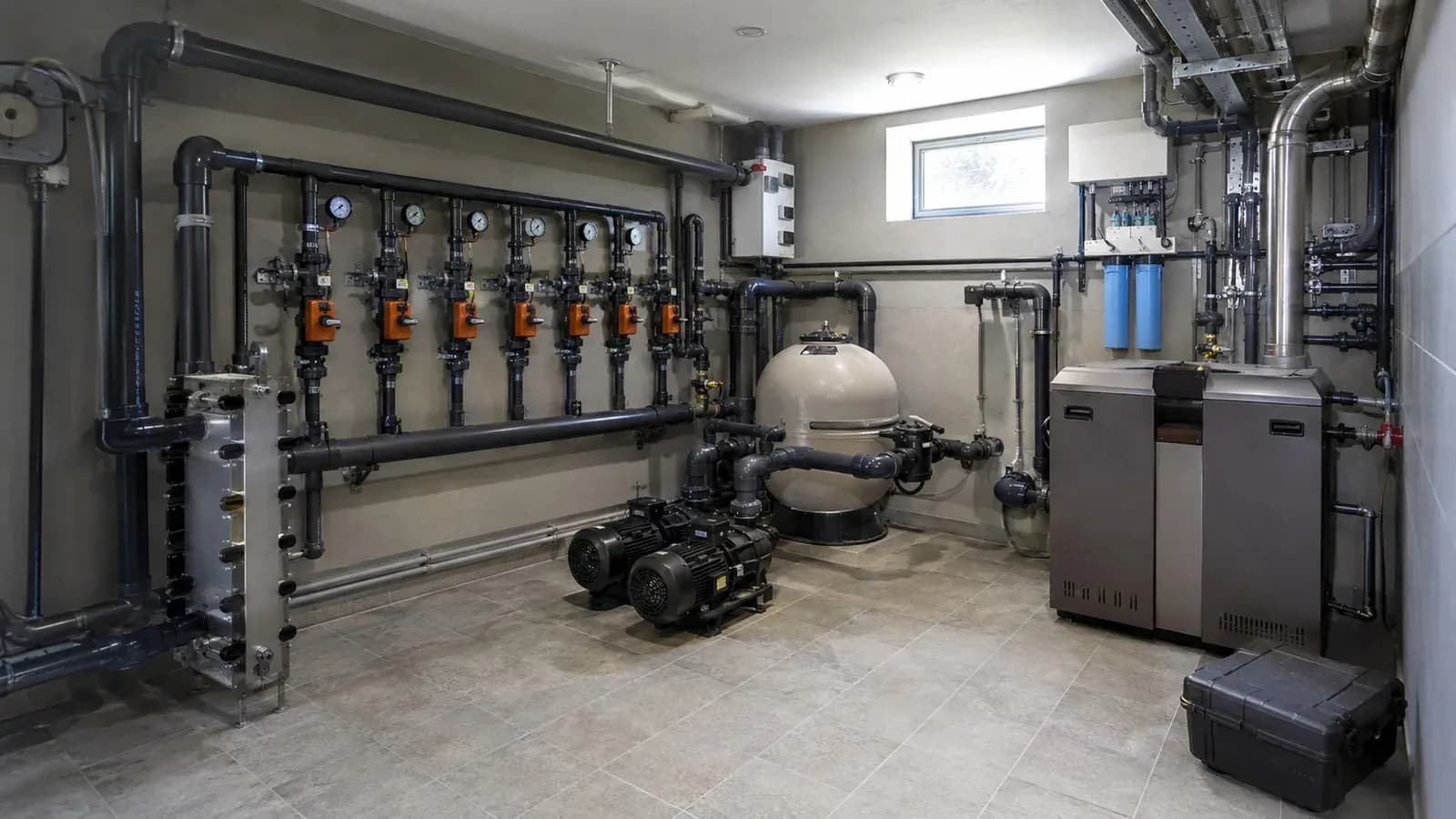
The exchanger transfers heat from a source, usually a gas boiler, into the pool water. And the reason for titanium specifically is that pool water contains chlorine, and saltwater pools contain salt as well — both eat through ordinary exchangers over time until they leak.
It suits: a pool that runs through winter rather than only in the warm season · anyone wanting fast heat-up to temperature in a short time · saltwater pools or those on high chlorine · and anyone with a **gas boiler** that could feed the pool from the same source.
The trade-off: it costs more to run than a heat pump. So if your pool only runs in the warm season and your priority is the lowest bill, the heat pump will usually save you more over time.
An existing boiler — the cheapest route if it works
If you have a working boiler in the house, it may be able to feed the pool through an exchanger — and that is the most economical thing you can do, because you reuse an existing heat source instead of buying a whole system.
But it is not guaranteed, and it turns on one question: can the boiler carry the pool load alongside hot water and heating at the same time? A pool is a large thermal load, and a boiler sized for the house alone will fall short across all three.
We work that out at the survey, and if the boiler cannot carry it we say so plainly rather than fitting something that will let you down in the first cold spell. Capacity and how it is calculated is covered in the right boiler capacity.
The difference, one line per point
Running cost: the heat pump is cheapest — the exchanger higher. Speed to temperature: the exchanger is faster — the heat pump slower. Performance in cold: the exchanger holds steady — the heat pump loses efficiency. Dependence on gas: the heat pump needs none — the exchanger and boiler do. Best season: the heat pump for an extended season — the exchanger for winter too.
And who says they are alternatives?
Many projects — and some villas — take both together: the heat pump carries the base load through the extended season at a low running cost, and the exchanger steps in during cold periods or when fast heat-up is needed.
That gives you the cheapest running across most of the year plus the ability to stretch the season to its edges. And that calculation is made on your pool's numbers, not a general rule — for projects and resorts it is done at facility level.
Before you decide — the cheapest improvement there is
Whatever you choose, a pool cover cuts evaporation losses noticeably, so any heating system runs fewer hours. If the budget allows, it is the cheapest improvement you can make to any pool setup — and its effect shows in the bill every month.
The next step
Book a survey — we measure pool volume, water surface area, your target temperature, whether it is covered, and the available energy source, then recommend the right system and the expected running cost before you pay. You can view our pool-heating solutions or start from the smart advisor.
Frequently Asked Questions
Which is best for heating a pool?
None is universally best. A heat pump is cheapest to run and suits an extended season and locations without gas; a titanium exchanger is faster and steadier in cold and suits winter running and saltwater pools.
There's no natural gas where I am — what do I do?
The heat pump is the practical answer, since it runs on electricity at high efficiency and needs no gas network. That is precisely its best case.
Why must the exchanger be titanium?
Pool water contains chlorine, and saltwater pools salt as well — both corrode ordinary exchangers over time until they leak. Titanium's corrosion resistance is very high, so it lasts far longer.
I have a boiler — can it feed the pool?
In some cases yes, and it is the most economical route since you reuse an existing source. It depends on whether the boiler can carry the pool load alongside hot water and heating — we calculate that at the survey and say plainly if it cannot.
Can I combine two systems?
Yes, and it is common on projects: the heat pump carries the base load at low cost, and the exchanger steps in during cold periods or for fast heat-up.
Does a cover really make a difference?
Yes, it cuts evaporation losses noticeably so any system runs fewer hours. It is the cheapest improvement you can make to any pool-heating setup.
Got a question about what you just read?
Talk to Aurora's team directly for a straight answer — or book a free site inspection if you're ready.